
Second Inventory Order Strategy for Amazon FBA Sellers

Second Inventory Order Strategy for Amazon FBA Sellers
One of the biggest mistakes Amazon sellers make is placing their second inventory order too early.
After a successful product launch, it is natural to feel excited. Sales are coming in, PPC campaigns are running, and inventory is moving faster than expected.
However, ordering more stock too quickly can become expensive.
Your first inventory order is not only for sales. It is also your first real market test.
Before placing a larger second order, Amazon FBA sellers should review customer feedback, product reviews, returns, ratings, and buyer complaints. These signals can show what needs to be fixed before scaling the product.
If you ignore this feedback, you may repeat the same mistakes at a bigger scale.
Why the First Inventory Order Matters
Your first Amazon FBA inventory order helps you test the market.
It shows how real customers respond to your product, listing, packaging, price, instructions, and overall quality.
This first batch can help you understand:
- What customers like
- What customers complain about
- Why buyers return the product
- Which features create trust
- Which issues reduce ratings
- Whether the packaging is strong enough
- Whether instructions are clear
- Whether the product needs improvement
As a result, the first inventory order becomes more than stock. It becomes customer research.
Why Placing the Second Order Too Early Is Risky
Many Amazon sellers place their second production order as soon as sales start increasing.
That decision may look smart at first. After all, no seller wants to run out of stock.
However, the problem is that customer feedback may not be complete yet.
If you place a large second inventory order before reviewing reviews and returns, you may multiply product problems.
For example, if customers complain about weak packaging and you reorder 3x more inventory with the same packaging, the issue becomes bigger.
Instead of scaling growth, you are scaling the mistake.
Table: First Order vs Second Order Strategy
| Area | First Inventory Order | Second Inventory Order |
| Main Purpose | Test market demand | Scale after learning |
| Key Focus | Sales, reviews, returns | Product improvement |
| Risk Level | Lower quantity, lower risk | Higher quantity, higher risk |
| Customer Feedback | Starts coming in | Should guide changes |
| Best Action | Monitor performance | Fix issues before reorder |
| Seller Goal | Validate product | Improve and scale |
Graph 1 Placement: Why Feedback Matters Before Reorder
Add graph here after the table.
Graph title: Customer Feedback Impact Before Second Order
Suggested graph type: Bar chart
| Feedback Area | Impact on Second Order Decision |
| Product quality complaints | 90 |
| Packaging issues | 80 |
| Missing accessory | 70 |
| Poor instructions | 65 |
| Return reasons | 85 |
| 3-star reviews | 75 |
| 1-star reviews | 95 |
Graph note:
This graph shows which customer feedback areas should be reviewed before placing the next Amazon FBA inventory order.
Review 3-Star and 1-Star Reviews First
Positive reviews are good for confidence.
However, negative and average reviews are more useful for product improvement.
Before placing your second order, pay close attention to:
- 1-star reviews
- 2-star reviews
- 3-star reviews
- Return comments
- Customer questions
- Product complaints
- Packaging complaints
- Support messages
These reviews often show what buyers expected but did not receive.
For Amazon Private Label sellers, this feedback is valuable because it comes directly from real customers.
What Questions Should Sellers Ask?
Before approving the second production run, ask these questions:
- Are customers repeating the same complaint?
- Is there a packaging issue?
- Is the product missing an accessory?
- Are the instructions unclear?
- Is the size, color, or material causing confusion?
- Are buyers returning the product for the same reason?
- Can product quality be improved?
- Can the listing explain the product better?
- Is there an opportunity to add more value?
In addition, check whether the issue is a product problem or a listing communication problem.
Sometimes the product is fine, but the listing creates the wrong expectation.
Product Feedback Can Improve Amazon Conversion Rate
Customer feedback does not only improve the product.
It can also improve your Amazon listing conversion rate.
For example, if customers say the product is smaller than expected, you may need a better size guide image. If buyers are confused about how to use the product, clear instructions or infographic images can help.
Better feedback analysis can improve:
- Product images
- Bullet points
- A+ Content
- Packaging
- Instructions
- Product quality
- Customer satisfaction
- Review rating
- Conversion rate
- Return rate
Therefore, feedback should guide both product development and listing optimization.
Graph 2 Placement: Risk of Scaling Without Feedback
Add graph here in the middle of the blog.
Graph title: Risk Increases When Reorder Quantity Grows
Suggested graph type: Line chart
| Inventory Stage | Order Quantity | Risk Level |
| First order | 500 | 30 |
| Second order | 1500 | 60 |
| Third order | 3000 | 80 |
| Bulk reorder | 5000 | 95 |
Graph note:
This graph shows how product issues become more costly as order quantity increases.
Why Your Second Order Should Be Better Than the First
Your second inventory order is your first real improvement opportunity.
By this stage, you should have enough early data to make smarter decisions.
You can improve:
- Packaging strength
- Insert card clarity
- Instruction manual
- Product material
- Product accessories
- Bundle value
- Labeling
- Quality control checklist
- Supplier specifications
- Listing content
As a result, the second batch should not simply repeat the first batch. It should be a better version of the product.
Do Not Ignore Returns and Refunds
Reviews are important, but returns also tell the real story.
Amazon FBA sellers should review return reasons before placing the next order.
Common return reasons include:
- Product not as described
- Item defective
- Poor quality
- Missing parts
- Wrong size
- Packaging damaged
- Difficult to use
- Customer changed mind
Some returns can be reduced by improving the product. Meanwhile, others can be reduced by improving the listing.
This is why return data should be reviewed with product reviews and customer questions.
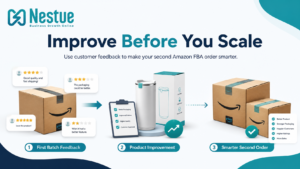
Second Inventory Order Checklist
| Checkpoint | What to Review | Why It Matters |
| Customer Reviews | 1-star, 2-star, 3-star feedback | Finds product issues |
| Return Reasons | Refund and return patterns | Reduces future returns |
| Packaging | Damage complaints | Protects customer experience |
| Instructions | Usage confusion | Improves satisfaction |
| Accessories | Missing parts or value gaps | Improves product offer |
| Listing Content | Images, bullets, A+ Content | Sets correct expectations |
| Supplier Specs | Material and quality standards | Prevents repeat mistakes |
| Reorder Quantity | Demand and risk level | Protects cash flow |
How Nestue Helps Amazon Sellers Improve Before Scaling
At Nestue, we do not treat the second order as a simple reorder.
We review real account data first.
Our team checks:
- Customer reviews
- Return reasons
- Listing conversion rate
- Product complaints
- Keyword performance
- PPC performance
- Inventory velocity
- Supplier and packaging issues
- SKU-level profitability
After that, we build a plan for the next batch.
This helps Amazon Private Label brands reduce returns, improve ratings, protect cash flow, and scale with more confidence.
Final Thoughts
A successful launch does not mean the product is perfect.
It means the market has started giving you data.
Before placing your second Amazon FBA inventory order, take time to review customer feedback, product reviews, return reasons, and quality issues.
A few weeks of patience can save thousands of dollars.
More importantly, it can help you improve ratings, reduce returns, increase customer satisfaction, and build a stronger Amazon brand.
The smartest growth strategy is not always ordering more inventory.
Sometimes, it is improving the product before you scale.
CTA
Planning your second Amazon FBA inventory order?
Book a free Amazon account audit with Nestue and let our team review your customer feedback, returns, listing, PPC, inventory, and growth plan before you reorder.
FAQs
Why should Amazon sellers wait before placing a second inventory order?
Sellers should wait because early customer reviews and return reasons can reveal product, packaging, or listing issues before scaling.
What should I check before reordering inventory for Amazon FBA?
Check customer reviews, return reasons, product complaints, packaging issues, listing clarity, PPC performance, and inventory velocity.
Why are 3-star reviews important for Amazon sellers?
3-star reviews often show useful improvement points. They are not fully negative, but they reveal what customers expected to be better.
Can customer feedback reduce Amazon returns?
Yes. Customer feedback can help improve product quality, packaging, instructions, and listing clarity, which can reduce future returns.
Should I reorder inventory if my Amazon launch is successful?
Yes, but only after reviewing customer feedback and confirming that the product is ready to scale.
How can Nestue help with Amazon inventory planning?
Nestue helps Amazon sellers review feedback, return reasons, listing performance, PPC data, inventory planning, and growth strategy before scaling.