
Amazon Product Variations: Why More Choice Can Improve Conversion Rate
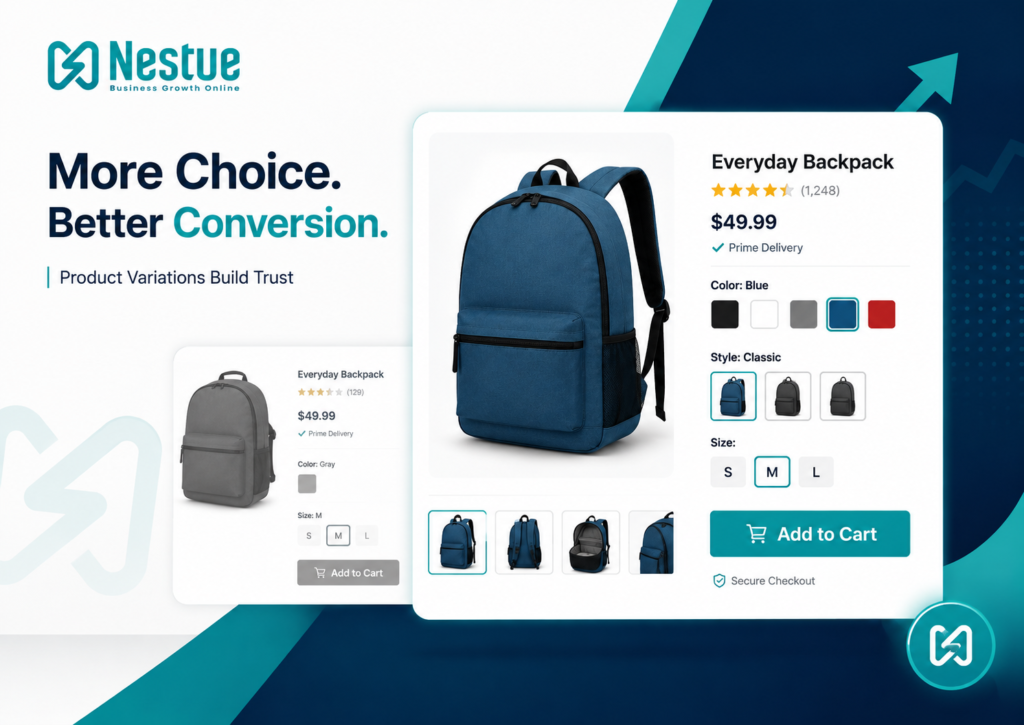
Amazon Product Variations: Why More Choice Can Improve Conversion Rate
One mistake can quietly hurt your Amazon conversion rate.
That mistake is not offering product variations when your competitors do.
Imagine a customer searches for your product on Amazon.
They open two listings.
One listing offers multiple colors, sizes, styles, or designs on the same product page. Meanwhile, your listing offers only one option.
Which listing feels more complete?
In many cases, shoppers naturally move toward the listing with more choices. However, this does not always mean they want a different variation. Sometimes, more options simply make the brand look more established, more professional, and more trustworthy.
For Amazon FBA sellers, product variations are not only a catalog feature. They can become a conversion rate advantage.
Why Amazon Product Variations Matter
Amazon shoppers want convenience.
If a buyer is interested in your product but wants a different color, size, or pack option, they should not have to leave your listing and return to search results.
A good Amazon variation listing helps shoppers compare options on the same page. As a result, they spend more time on your listing and have fewer reasons to click a competitor.
Product variations can help improve:
- Amazon listing conversion rate
- Customer shopping experience
- Review accumulation
- Product page trust
- Organic ranking potential
- PPC conversion performance
- Customer retention on the listing
- Brand perception
Therefore, variations should be part of your Amazon listing optimization strategy, especially when the market already expects multiple options.
Table: Single Listing vs Variation Listing
| Area | Single Option Listing | Variation Listing |
| Customer Choice | Limited | Multiple options |
| Trust Level | Can look basic | Looks more established |
| Review Strength | Reviews stay separate | Reviews may consolidate properly |
| Shopping Experience | Customer may leave listing | Customer can compare on one page |
| Conversion Potential | Lower if choice is missing | Higher if options match demand |
| PPC Efficiency | Traffic may drop off | Traffic has more chances to convert |
| Competitive Position | Weak if competitors offer options | Stronger against similar listings |
Graph 1 Placement: How Variations Can Improve Buyer Confidence
Add graph here after the table.
Graph title: Product Options and Buyer Confidence
Suggested graph type: Bar chart
| Listing Type | Buyer Confidence |
| One option only | 45 |
| 2 variations | 60 |
| 4 variations | 78 |
| 6 meaningful variations | 85 |
Graph note:
This graph shows how meaningful product options can help improve customer confidence before purchase.

Variations Can Increase Conversion Potential
Amazon product variations help customers find the option that matches their preference.
For example, a shopper may like your product but prefer another color. Another buyer may want a different size. Someone else may need a different pack count.
If these options are available on your listing, the customer can stay and buy.
However, if your listing has only one option, that same shopper may go back to search results and choose a competitor.
This is why variations can directly support Amazon conversion rate optimization.
Better choice often creates better buying confidence.
Better Shopping Experience Keeps Customers on Your Listing
A strong Amazon listing should reduce friction.
When customers need to open multiple listings to compare colors, sizes, or designs, the shopping experience becomes harder.
Variations solve this problem.
They allow shoppers to compare available options without leaving the product detail page. In addition, they make the product page feel more complete.
This can reduce customer drop-off and improve the chance of conversion.
For Amazon PPC campaigns, this also matters. If paid traffic lands on your listing, you want to give that shopper every reason to stay.
Product Variations Can Support Review Accumulation
Reviews are one of the strongest trust signals on Amazon.
When variation families are created correctly and follow Amazon’s variation policy, reviews may appear together across related child ASINs. This can create stronger social proof for the product family.
For a new Amazon Private Label brand, this can be valuable.
A variation family with stronger reviews can help:
- Improve customer trust
- Increase click-to-order ratio
- Support PPC performance
- Improve listing conversion
- Build stronger social proof
- Help new variations gain traction faster
However, sellers must use variations correctly. Unrelated products should not be grouped together because this can create compliance risk.
Graph 2 Placement: Why Customers Stay on Variation Listings
Add graph here in the middle of the blog.
Graph title: Reasons Variations Help Customers Stay
Suggested graph type: Bar chart
| Reason | Impact Score |
| More color choices | 80 |
| Size comparison | 75 |
| Better review trust | 85 |
| Easier decision-making | 78 |
| Less need to return to search | 90 |
Graph note:
This graph shows why product variations can reduce drop-off and improve the customer shopping experience.
The Common Mistake: Launching One Variation and Waiting Too Long
Many sellers think:
“I will launch one variation first and add more later.”
That can make sense when testing demand.
However, staying with one variation for too long can limit growth, especially if competitors already offer multiple options.
For example, if competitors offer Black, White, Gray, Blue, and Red while your listing only offers Black, you are giving customers fewer reasons to stay.
In this situation, your listing may look less complete even if your product quality is strong.
Therefore, sellers should study the market before deciding how many variations to launch.
Variations Should Be Meaningful, Not Random
The goal is not to create variations just for the sake of it.
Instead, sellers should offer meaningful choices that customers actually want.
Good variation options may include:
- Color
- Size
- Quantity
- Pack count
- Style
- Design
- Scent
- Pattern
- Material option
However, every variation should make sense for the product category.
If customers do not care about a specific variation, it may only create unnecessary inventory complexity.

Product Variation Checklist for Amazon Sellers
| Checkpoint | What to Review | Why It Matters |
| Competitor Options | Colors, sizes, designs, packs | Shows what the market expects |
| Customer Demand | Which options buyers actually want | Avoids unnecessary inventory |
| Review Strategy | Variation family structure | Builds stronger social proof |
| Listing Accuracy | Titles, images, bullets | Prevents customer confusion |
| Inventory Planning | Stock for each variation | Avoids stockouts by child ASIN |
| PPC Strategy | Campaigns by variation performance | Improves budget control |
| Profit Margin | Cost and price by option | Protects profitability |
| Compliance | Amazon variation rules | Reduces listing risk |
How Variations Can Improve PPC Performance
Amazon PPC does not only depend on keywords and bids.
It also depends on conversion rate.
If shoppers click your ad but do not find the option they want, your PPC spend can become less efficient. On the other hand, a strong variation listing gives paid traffic more chances to convert.
This can help improve:
- ACoS
- ROAS
- CTR
- CVR
- Sales velocity
- Organic ranking potential
- Customer engagement
As a result, before spending more on Amazon PPC, sellers should ask whether the product listing offers enough choice.
Sometimes the issue is not traffic.
The issue is the listing experience.
How Nestue Helps With Amazon Variation Strategy
At Nestue, we review product variations as part of Amazon listing optimization and growth strategy.
Our team checks:
- Competitor variation structure
- Customer demand by option
- Listing conversion rate
- Review and rating position
- PPC performance by variation
- Inventory risk
- Parent-child listing setup
- Organic ranking opportunities
- Profitability by SKU
This helps Amazon Private Label sellers understand whether variations can improve conversion, customer trust, and long-term growth.
Final Thoughts
Amazon customers want options.
If competitors offer multiple colors, sizes, or designs while your listing offers only one, your conversion rate may suffer quietly.
Product variations can improve customer experience, build trust, support review accumulation, reduce drop-off, and help PPC traffic convert better.
However, variations must be meaningful.
The goal is not to add random options. The goal is to give shoppers the choices they already expect.
Before increasing your PPC budget, ask one important question:
Are you losing customers because of traffic, or because your listing does not offer enough choice?
CTA
Is your Amazon listing losing customers because it offers fewer options than competitors?
Book a free Amazon listing audit with Nestue and let our team review your variation strategy, conversion rate, PPC performance, and growth opportunities.
FAQs
What are Amazon product variations?
Amazon product variations are related product options grouped under one parent listing, such as different colors, sizes, styles, or pack counts.
Do variations improve Amazon conversion rate?
Yes, meaningful variations can improve conversion rate because customers can choose the option they prefer without leaving the listing.
Should every Amazon product have variations?
No. Variations should only be used when they make sense for the product and match customer demand.
Can Amazon variations help with reviews?
Proper variation families may help consolidate review visibility across related child ASINs, which can improve social proof.
Can variations improve Amazon PPC performance?
Yes. If variations improve conversion rate, PPC traffic may become more efficient and profitable.
How can Nestue help with Amazon variations?
Nestue helps sellers review competitor variation gaps, parent-child structure, listing conversion, PPC performance, and inventory planning.