
Amazon Product Bundling Policy Update: What Sellers Should Review Before January 11, 2027
Amazon is introducing important changes to its product bundling policy.
Starting January 11, 2027, sellers who offer product bundles on Amazon should review their existing listings, packaging setup, and authorization documents.
The biggest update is simple.
Most product bundles listed as a single ASIN will generally need to be packaged by the original manufacturer or brand.
This matters for Amazon FBA sellers, resellers, Private Label brands, and catalog teams because noncompliant bundle listings may be deactivated after the deadline. In addition, Amazon may record these issues as listing violations in Account Health.
Therefore, sellers should not wait until the policy takes effect.
If your catalog includes bundles, multi-product kits, repackaged offers, gift sets, or mixed-brand bundles, this is the right time to audit them.
What Is an Amazon Product Bundle?
An Amazon product bundle is a listing that combines multiple products and sells them together under one ASIN.
For example, a seller may create:
- A skincare bundle
- A kitchen accessories kit
- A camera accessory bundle
- A gift set
- A multi-product household bundle
- A consumable product bundle
- A product with related accessories
Bundles can help sellers increase average order value, improve customer convenience, and create a stronger product offer.
However, Amazon wants bundle listings to be clear, compliant, and properly packaged.
This is why the new Amazon product bundling requirements are important.
What Is Changing in Amazon’s Bundling Policy?
The main change is that most product bundles sold as a single ASIN must be packaged by the original manufacturer or brand.
This means sellers may no longer be able to freely combine products into a physical bundle unless they meet specific conditions.
Amazon is also creating some new opportunities by removing previous restrictions in certain areas.
The update includes:
- Original manufacturer or brand packaging requirement
- Authorized repackaged bundle option
- Exempt categories
- Continued use of Virtual Bundles
- Expanded bundle options in selected categories
- Possible listing deactivation for noncompliance
- Possible Account Health violations after the deadline
For sellers, this update is both a risk and an opportunity.
Table: Current Bundle Setup vs New Policy Requirement
| Area | Before Policy Update | After January 11, 2027 |
| Physical Bundles | Sellers may create many bundle types | Must be manufacturer or brand packaged |
| Repackaged Bundles | More flexible in some cases | May require Letter of Authorization |
| Virtual Bundles | Available for eligible brand owners | Can continue because items are not physically packed together |
| Category Rules | Some restrictions applied | Some restrictions may be removed |
| Compliance Risk | Listing issues possible | Noncompliant bundles may be deactivated |
| Account Health | Depends on issue type | Violations may be recorded after deadline |
Graph 1 Placement: Bundle Compliance Risk by Setup Type
Add graph here after the table.
Graph title: Amazon Bundle Compliance Risk by Listing Type
Suggested graph type: Bar chart
| Bundle Type | Compliance Risk |
| Manufacturer-packaged bundle | 20 |
| Authorized repackaged bundle | 35 |
| Virtual Bundle | 25 |
| Unapproved seller-made bundle | 90 |
| Mixed-brand bundle without authorization | 95 |
| Unclear bundle packaging | 80 |
Graph note:
This graph shows why Amazon sellers should review bundle structure and authorization before January 11, 2027.
1. Original Manufacturer Packaging Will Generally Be Required
The biggest part of this update is the packaging requirement.
Starting January 11, 2027, most product bundles listed as a single ASIN must be packaged by the original manufacturer or brand.
This means sellers should check whether their current bundles are:
- Factory packed
- Brand packed
- Seller repackaged
- Mixed-brand
- Manually assembled
- FBA prepped as a bundle
- Listed as one ASIN
- Sold through Virtual Bundles
If the bundle is not packaged by the original manufacturer or brand, it may need further review.
This is especially important for sellers who create their own kits by combining products from different suppliers or brands.
2. Authorized Repackaged Products May Still Be Allowed
Amazon’s update also mentions authorized repackaged products.
This means sellers may be able to create and sell repackaged bundles if they have permission from the brand owner or manufacturer.
The key document is a Letter of Authorization.
A Letter of Authorization should clearly show that the brand owner or manufacturer allows the seller to repackage and sell the product bundle.
For Amazon sellers, this document can become very important.
Before the deadline, sellers should check:
- Do you have written authorization?
- Does the authorization mention repackaging?
- Does it cover the products inside the bundle?
- Does it identify the brand or manufacturer clearly?
- Does it apply to Amazon marketplace sales?
- Is the document current and valid?
Without proper authorization, a repackaged bundle may create listing compliance risk.
3. Some Categories Are Exempt
Amazon is also allowing exemptions for certain areas.
According to the update provided, certain gifting browse nodes and camera product types are exempt from the original-manufacturer configuration requirement.
This means not every bundle will be treated the same way.
However, sellers should not assume their products are exempt without checking the category and product type.
For example, if your bundle is listed in a gifting browse node, you should still confirm whether the exemption applies to your exact product setup.
If your product is in a camera-related category, review the product type, bundle structure, and category rules before making changes.
4. Virtual Bundles Can Continue
Amazon’s Virtual Bundles tool is still important.
Brand owners and authorized resellers can continue using Virtual Bundles because these products are not physically packaged together.
This is a major difference.
A physical bundle is packed together and sold as one ASIN.
A Virtual Bundle allows eligible sellers to group products together on Amazon while the items remain separate in FBA inventory.
For many brands, Virtual Bundles may become a safer way to create bundle offers without physically repackaging products.
Graph 2 Placement: Physical Bundles vs Virtual Bundles
Add graph here in the middle of the blog.
Graph title: Bundle Strategy Comparison for Amazon Sellers
Suggested graph type: Bar chart
| Strategy Area | Physical Bundle | Virtual Bundle |
| Packaging control | 90 | 35 |
| Compliance review needed | 85 | 45 |
| FBA inventory simplicity | 50 | 80 |
| Customer offer flexibility | 75 | 85 |
| Repackaging risk | 80 | 20 |
Graph note:
This graph shows why sellers should compare physical bundles and Virtual Bundles before updating their catalog.
New Opportunities for Amazon Sellers
This policy update is not only about restrictions.
Amazon is also expanding bundle options in selected areas.
The update mentions expanded opportunities for:
- Books
- Music
- Video
- DVDs
- Video games
- Gift cards
- Service plans
- Certain multi-brand Consumables bundles with authorization
This may help sellers create more structured bundle offers, especially when authorization is available.
However, sellers should still make sure every bundle follows Amazon’s requirements.
A bundle opportunity is only useful if the listing stays active and compliant.
Why This Policy Matters for Account Health
Noncompliant bundle listings can create serious problems.
After January 11, 2027, Amazon may deactivate bundle listings that do not meet the updated requirements. These issues may also appear as listing violations in Account Health.
That can affect:
- Listing visibility
- Sales continuity
- Product launch plans
- FBA inventory movement
- Brand trust
- Account performance
- Cash flow
For Amazon sellers, bundle compliance should not be treated as a small catalog task.
It can directly impact revenue.
Amazon Bundle Compliance Checklist
| Checklist Item | What to Review | Why It Matters |
| Bundle ASINs | Identify all bundle listings | Finds affected products |
| Packaging Source | Manufacturer, brand, or seller packed | Confirms policy risk |
| Authorization | Check Letter of Authorization | Supports repackaged bundles |
| Product Type | Confirm category and browse node | Identifies exemptions |
| Virtual Bundle Option | Review if eligible | May reduce physical repackaging risk |
| Brand Ownership | Confirm brand owner or reseller status | Affects available tools |
| Account Health | Monitor listing violations | Protects selling account |
| Deadline | January 11, 2027 | Avoids late compliance issues |
Common Mistakes Sellers Should Avoid
Many sellers wait until Amazon suppresses or removes a listing.
That is risky.
Common mistakes include:
- Assuming all bundles are still allowed
- Creating seller-made bundles without authorization
- Mixing brands without clear permission
- Ignoring manufacturer packaging rules
- Not checking Virtual Bundles as an alternative
- Waiting until January 2027 to audit listings
- Not saving authorization documents
- Listing repackaged products without proof
- Ignoring Account Health warnings
- Treating bundle compliance as only a catalog issue
Instead, sellers should review listings early and prepare documentation before enforcement begins.
How This Affects Amazon FBA Sellers
Amazon FBA sellers need to be especially careful with physical bundles.
If your products are already packed and sent to FBA, changing bundle structure later can become difficult.
A compliance issue can leave sellers with:
- Inventory stuck at FBA
- Deactivated ASINs
- Removal order costs
- Repackaging problems
- Lost sales
- Delayed launches
- Cash flow pressure
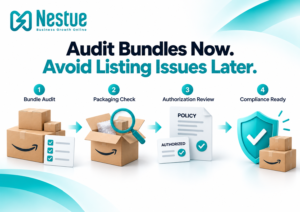
Therefore, sellers should review bundle compliance before sending new inventory to Amazon.
If a bundle needs to be changed, it is better to make that decision before production, packaging, and shipment.
How Nestue Helps Amazon Sellers With Bundle Compliance
At Nestue, we help Amazon sellers stay prepared for marketplace policy updates.
Our team reviews:
- Product bundle listings
- Parent and child ASIN structure
- Manufacturer packaging details
- Authorization documents
- Virtual Bundle opportunities
- Listing compliance risks
- Account Health issues
- Inventory planning impact
- Product detail page strategy
- Conversion and sales opportunities
This helps sellers protect listings while still using bundles strategically for growth.
Final Thoughts
Amazon’s updated product bundling policy will affect sellers who offer physical bundles.
Starting January 11, 2027, most bundles listed as a single ASIN will generally need to be packaged by the original manufacturer or brand.
Authorized repackaged bundles may still be allowed with a Letter of Authorization. In addition, Virtual Bundles remain an important option for eligible sellers.
The best move is to review your listings now.
Check your packaging, confirm authorization, review exemptions, and prepare before Amazon starts enforcement.
A bundle can be a strong Amazon growth strategy.
However, it must be compliant first.
CTA
Selling bundles on Amazon?
Book a free Amazon bundle compliance review with Nestue and let our team review your bundle listings, packaging setup, authorization documents, Virtual Bundle options, and Account Health risks.
FAQs
What is Amazon’s product bundling policy update?
Amazon is updating its product bundling requirements. Starting January 11, 2027, most physical bundles listed as one ASIN must generally be packaged by the original manufacturer or brand.
When does the new Amazon bundling policy take effect?
The new Amazon product bundling policy takes effect on January 11, 2027.
Can sellers still create repackaged bundles?
Yes, but sellers may need a Letter of Authorization from the brand owner or manufacturer that allows repackaging.
Are Virtual Bundles still allowed?
Yes. Brand owners and authorized resellers can continue using Amazon’s Virtual Bundles tool because those products are not physically packaged together.
What happens to noncompliant bundles?
Noncompliant bundles may be deactivated and recorded as listing violations in Account Health after the deadline.
How can Nestue help?
Nestue helps sellers review bundle listings, packaging requirements, authorization documents, Virtual Bundle options, and Amazon Account Health risks.