
Amazon Business Deals: New B2B Discount Opportunity for Sellers
September 2, 2026
Amazon has introduced Amazon Business Deals, a new way for eligible sellers to create limited-time discounts for Amazon Business customers.
This update gives sellers another opportunity to reach B2B buyers, improve product visibility, and increase sales from business accounts.
Starting August 31, 2026, Amazon says sellers can create exclusive deals for business customers through Amazon Business Deals. The feature is available through the Price Discounts tool in Seller Central for products that already have Business Prices.
For Amazon FBA sellers and Private Label brands, this update matters because B2B buyers often purchase differently from normal retail customers.
They may buy in larger quantities, compare business pricing, look for repeat supply, and respond well to structured discounts.
What Are Amazon Business Deals?
Amazon Business Deals are limited-time promotions created only for Amazon Business customers.
Instead of offering a public discount to every shopper, sellers can create a B2B-exclusive offer for registered business buyers.
Amazon says these deals can last from 1 hour to 30 days, and sellers can choose between Fixed Price or Percent Off promotions.
This gives sellers more flexibility when building Amazon B2B pricing strategies.
For example, a seller can create:
-
A short deal for business buyers
-
A longer B2B promotion for inventory movement
-
A discount during major sales events
-
A targeted offer for products with strong business demand
As a result, sellers can separate their Amazon Business strategy from normal retail discounting.
Why Amazon Business Deals Matter for Sellers
Amazon Business is not only for office supplies.
Many product categories can attract business buyers, including cleaning products, packaging supplies, tools, electronics accessories, storage items, kitchen products, industrial supplies, and bulk-use consumables.
If your product solves a repeat business need, Amazon Business Deals can help you reach buyers who may place larger or repeat orders.
This can support:
-
Amazon B2B sales
-
Business customer visibility
-
Product discoverability
-
Bulk buyer interest
-
Inventory movement
-
Revenue growth
-
Repeat order potential
-
Brand awareness among business accounts
However, sellers should still protect profit margins before offering any discount.
A deal can increase sales, but it should not create unprofitable volume.
Table: Regular Amazon Deals vs Amazon Business Deals
Area |
Regular Amazon Deals |
Amazon Business Deals |
Customer Type |
General Amazon shoppers |
Amazon Business customers |
Deal Visibility |
Public retail audience |
B2B buyer audience |
Pricing Goal |
Retail conversion |
Business purchasing demand |
Best Use |
Consumer sales events |
Business buyers and bulk demand |
Discount Type |
Retail promotions |
Fixed Price or Percent Off |
Seller Strategy |
Broad traffic |
Targeted B2B growth |
Graph 1 Placement: B2B Deal Opportunity Areas
Add graph here after the table.
Graph title: Where Amazon Business Deals Can Help Sellers
Suggested graph type: Bar chart
Opportunity Area |
Impact Score |
B2B visibility |
90 |
Bulk order potential |
85 |
Inventory movement |
75 |
Repeat buyer demand |
80 |
Deal event exposure |
70 |
Catalog differentiation |
65 |
Graph note:
This graph can show how Amazon Business Deals may support sellers with products that appeal to business buyers.
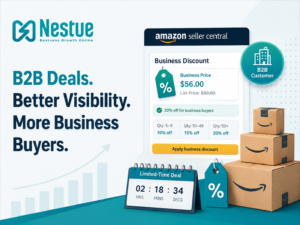
Amazon Business Deals Eligibility Requirements
Amazon Business Deals are not available for every product automatically.
According to Amazon’s seller update, products must meet eligibility requirements, including a 3.5+ star rating, new condition, Amazon pricing requirements, and seller performance standards. Regular deals require at least 10% off, while High Velocity Event deals such as Prime Big Deal Days, Black Friday, and Cyber Monday require at least 15% off.
This means sellers should review their catalog before planning promotions.
Important checks include:
-
Star rating
-
Product condition
-
Business Price setup
-
Seller performance
-
Pricing history
-
Minimum discount level
-
Profit margin
-
Inventory availability
-
Event timing
In addition, products need existing Business Prices to access Amazon Business Deals through the Price Discounts tool.
Why Business Prices Matter
Amazon Business Deals work with products that already have Business Prices.
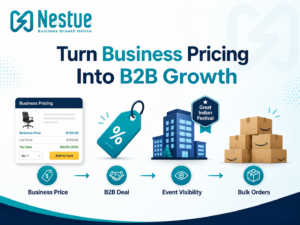
Business Price is a seller-set price available to Amazon Business customers. It allows sellers to create different pricing for B2B buyers while keeping normal retail pricing separate.
This matters because business buyers often compare value differently.
They may care about:
-
Unit cost
-
Bulk savings
-
Repeat supply
-
Delivery reliability
-
Business-only pricing
-
Quantity discounts
-
Purchase approval needs
-
Invoice-friendly ordering
Therefore, sellers who want to grow Amazon B2B sales should review Business Price setup before creating deals.
Graph 2 Placement: B2B Deal Readiness Score
Add graph here in the middle of the blog.
Graph title: Amazon Business Deals Readiness Checklist
Suggested graph type: Bar chart
Readiness Area |
Score |
Business Price active |
95 |
3.5+ rating |
90 |
Inventory available |
85 |
Profit margin checked |
88 |
Discount level planned |
80 |
Event calendar reviewed |
70 |
Graph note:
This graph can help sellers check whether their products are ready for Amazon Business Deals.
How Sellers Can Use Amazon Business Deals Strategically
Amazon Business Deals should not be used randomly.
A better approach is to select products that already have business buyer potential.
Good candidates may include:
-
Products bought in bulk
-
Office or workplace items
-
Packaging supplies
-
Cleaning products
-
Industrial accessories
-
Kitchen or hospitality items
-
Repeat use products
-
Products with stable margins
-
Items with strong reviews
-
Products with enough inventory
For example, a packaging brand selling bubble wrap, poly mailers, labels, or storage products may use Amazon Business Deals to attract offices, warehouses, ecommerce brands, and small businesses.
As a result, B2B deals can become part of a larger Amazon growth strategy.
Common Mistakes Sellers Should Avoid
Many sellers create deals without checking profit first.
That can create revenue without real growth.
Common mistakes include:
-
Offering discounts without margin calculation
-
Running deals with low inventory
-
Ignoring Business Price setup
-
Not checking product eligibility
-
Applying B2B deals to weak products
-
Forgetting event discount requirements
-
Not reviewing ACoS and TACoS impact
-
Treating B2B buyers like normal retail customers
-
Not tracking repeat business orders
Instead, sellers should use Amazon Business Deals with clear goals.
The goal may be visibility, bulk order testing, inventory movement, repeat buyer acquisition, or event promotion.
Amazon Business Deals Checklist for Sellers
Checklist Item |
What to Review |
Why It Matters |
Business Price |
Confirm product has Business Price |
Required for access |
Rating |
Check 3.5+ star rating |
Supports eligibility |
Product Condition |
Must be new |
Meets deal standards |
Discount |
10% regular, 15% event |
Meets minimum requirements |
Inventory |
Enough stock for demand |
Avoids stockout risk |
Margin |
Profit after discount |
Prevents unprofitable sales |
Event Calendar |
Prime Big Deal Days, Black Friday, Cyber Monday |
Improves planning |
B2B Demand |
Business buyer use case |
Helps choose the right ASINs |
How Amazon Business Deals Can Support PPC and Organic Growth
Amazon Business Deals are mainly a pricing and promotion tool.
However, better conversion from business buyers can also support broader listing performance.
If a deal helps generate more sales, it may improve:
-
Sales velocity
-
Product visibility
-
Listing conversion rate
-
Inventory movement
-
Repeat purchase behavior
-
B2B ranking potential
-
PPC efficiency
However, sellers should monitor performance carefully.
A deal that increases orders but destroys margin is not a successful strategy.
Therefore, Amazon sellers should track revenue, profit, unit sales, business orders, and advertising impact during and after the deal.
How Nestue Helps Amazon Sellers With B2B Growth
At Nestue, we help Amazon sellers review growth opportunities beyond normal retail PPC.
Our team checks:
-
Business Price setup
-
Amazon Business eligibility
-
B2B discount strategy
-
Product-level margin
-
Inventory readiness
-
Listing conversion rate
-
PPC performance
-
Deal calendar
-
Event promotion planning
-
Catalog growth opportunities