
Amazon FBA Fee Overcharges: How Sellers Can Recover Lost Profit
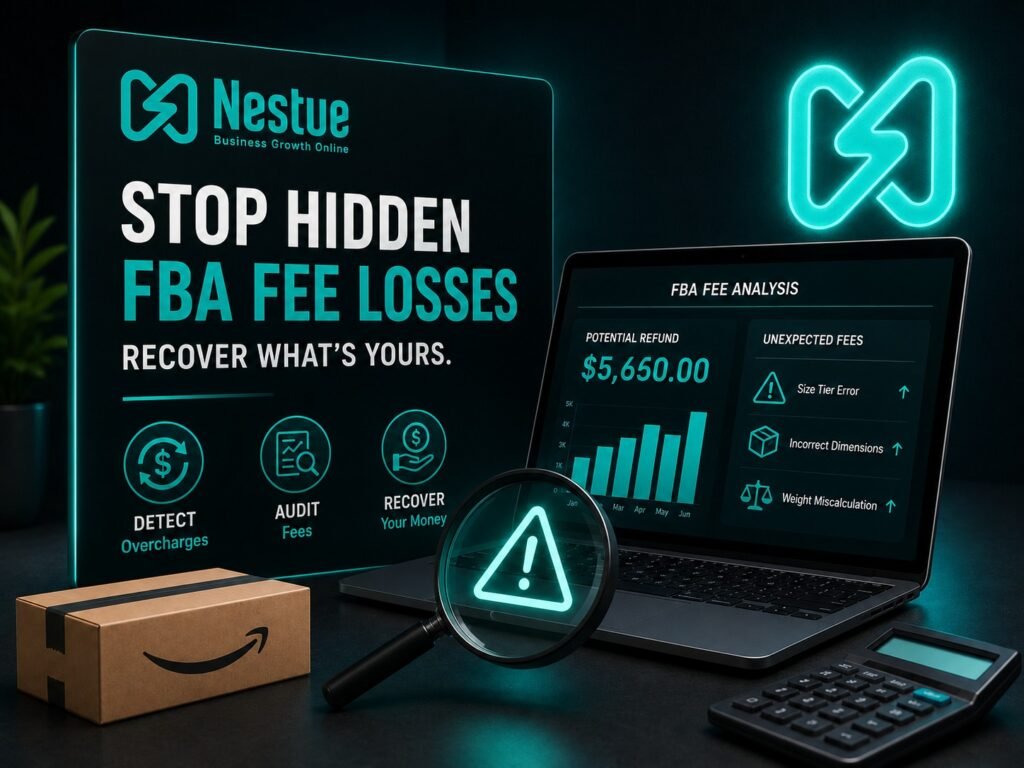
Amazon FBA Fee Overcharges: How Sellers Can Recover Lost Profit
Amazon FBA sellers may be losing profit without even noticing it.
Many sellers carefully track product cost, PPC spend, referral fees, and storage fees, but they often miss one hidden problem: Amazon FBA fee overcharges.
These overcharges usually happen when Amazon charges higher fulfillment or storage fees than your product should actually qualify for. The issue can come from incorrect product dimensions, wrong weight data, size tier misclassification, or fulfillment system errors.
One small fee mistake may not look serious. But when the same error repeats across hundreds or thousands of orders, it can quietly drain your cash flow and reduce your Amazon profit margin.
For Amazon Private Label sellers, this can make a profitable product look weaker over time.
What Are Amazon FBA Fee Overcharges?
Amazon FBA fee overcharges happen when Amazon charges more than the correct fee for storing, handling, or fulfilling your product.
This can happen because Amazon may classify your product under the wrong size tier or use incorrect product measurement data.
For example, if your product is measured slightly larger or heavier than its actual size, it may move into a higher Amazon FBA fee tier. That means you pay more per order, even though the product itself has not changed.
Common overcharge areas include:
- FBA fulfillment fees
- FBA storage fees
- Size tier classification
- Product weight errors
- Product dimension errors
- Inbound or outbound handling fees
- Removal or disposal fees
- Reimbursement-related errors
These hidden Amazon seller fee issues can reduce profitability without appearing as an obvious problem in daily sales reports.
Why FBA Fee Overcharges Hurt Seller Cash Flow
Amazon sellers already deal with many costs.
These include product cost, freight, duties, FBA fees, referral fees, storage fees, PPC spend, refunds, returns, and promotions.
When Amazon FBA fee overcharges are added on top of these costs, margins become even tighter.
FBA fee overcharges can:
- Reduce profit on every unit sold
- Lower monthly cash flow
- Increase fulfillment costs
- Reduce money available for PPC
- Reduce money available for inventory reorder
- Make SKU profitability look weaker
- Create hidden annual losses
- Limit growth and reinvestment capacity
For a single unit, the overcharge may be small. But across 5,000 or 10,000 units, the loss can become significant.
That is why Amazon sellers should not only track sales. They should also audit fees regularly.
Common Reasons Amazon FBA Fee Overcharges Happen
Amazon FBA overcharges usually happen because of measurement, classification, or fulfillment system issues.
1. Incorrect Cubiscan Measurements
Amazon uses automated systems to measure product dimensions and weight inside fulfillment centers.
Sometimes these measurements can be incorrect.
A small measurement error can push your product into a higher FBA size tier, increasing your fulfillment fee.
For example:
| Issue | Impact |
| Product measured too large | Higher size tier |
| Product weight recorded incorrectly | Higher fulfillment fee |
| Packaging included incorrectly | Higher dimensional weight |
| Wrong measurement update | Repeated overcharge |
If your product dimensions in Seller Central do not match your real product specs, you may be paying extra fees.
2. Wrong Size Tier Classification
Amazon FBA fees depend heavily on size tier.
If your product is placed in the wrong Amazon size tier, you may pay higher fulfillment fees on every order.
This can happen after:
- Amazon measurement updates
- Packaging changes
- Catalog updates
- Fulfillment center processing
- System errors
- Variation-level data changes
A size tier mistake can quietly continue until the seller finds it and requests correction.
3. Fulfillment Center Packaging Decisions
Sometimes Amazon may pack or process products in a way that changes the fulfillment fee calculation.
If your product is handled in larger packaging, or if dimensions are recorded incorrectly during fulfillment, it may increase the fee.
This can affect sellers with products that are close to Amazon’s size tier limits.
Products near a size tier boundary are especially risky because even a small measurement change can increase fees.
How to Identify Amazon FBA Fee Overcharges
Amazon sellers should review their FBA fees regularly inside Seller Central.
The goal is to compare Amazon’s recorded data with your actual product data.
1. Review the FBA Fee Preview Report
The FBA Fee Preview Report helps sellers check estimated fulfillment fees by ASIN.
Look for:
- Sudden fee increases
- Unexpected fulfillment fee changes
- ASINs with higher fees than expected
- Products moved into a different size tier
- Repeated fee changes on the same SKU
If a fee changes without a product or packaging change, it should be investigated.
2. Compare Amazon Data With Actual Product Specs
Check your real product dimensions and weight.
Then compare them with Amazon’s recorded measurements.
Review:
- Product length
- Product width
- Product height
- Unit weight
- Package weight
- Dimensional weight
- Size tier
Even small differences can affect Amazon FBA fees.
3. Check Size Tier Mismatches
Amazon size tier mistakes are one of the most common reasons for FBA fee overcharges.
If your product is listed in the wrong size tier, your fulfillment fee may be higher than it should be.
Sellers should check whether each ASIN is correctly classified based on actual product size and weight.
4. Monitor Fulfillment Fee Spikes
If your FBA fulfillment fee suddenly increases, check the reason.
Ask:
- Did the product packaging change?
- Did Amazon update the dimensions?
- Did the weight change?
- Did the size tier change?
- Did this happen to one ASIN or multiple ASINs?
Unexpected fee spikes can be a sign of Amazon FBA overcharges.
Amazon FBA Fee Audit Checklist
| Audit Area | What to Check | Why It Matters |
| FBA Fee Preview Report | Fulfillment fee by ASIN | Finds sudden fee changes |
| Product Dimensions | Length, width, height | Incorrect dimensions increase fees |
| Product Weight | Unit and package weight | Weight errors affect size tier |
| Size Tier | Amazon classification | Wrong tier means higher cost |
| Fee History | Repeated fee changes | Shows ongoing overcharge patterns |
| SKU Profitability | Net margin after fees | Confirms real profit impact |
Steps to Recover Money From FBA Fee Overcharges
If you find a possible Amazon FBA fee overcharge, follow a proper process.
Step 1: Download the FBA Fee Preview Report
Start by downloading the report from Seller Central and reviewing your ASIN-level fulfillment fees.
Step 2: Compare With Actual Product Specs
Use your real product measurements and packaging details to compare against Amazon’s data.
Step 3: Flag Size Tier Issues
Identify products that may be incorrectly classified in a higher size tier.
Step 4: Cross-Check Fee Details
Review fee changes, order history, and product dimensions to confirm the issue.
Step 5: Submit Remeasurement Request
If Amazon’s measurements are incorrect, request a product remeasurement inside Seller Central.
Step 6: File Reimbursement Case
If the overcharge is confirmed, submit a reimbursement case with clear evidence.
Include:
- ASIN
- SKU
- Actual product dimensions
- Actual product weight
- Amazon’s recorded dimensions
- Fee difference
- Supporting images or documentation
- Date range of overcharge
A clear case improves the chance of successful recovery.
How Sellers Can Prevent FBA Fee Overcharges
Amazon sellers should not wait until margins drop.
A regular fee audit can help prevent long-term profit loss.
1. Optimize Product Packaging
Packaging should be designed to stay within the correct Amazon FBA size tier.
Avoid unnecessary space, oversized boxes, or packaging that pushes the product into a higher fee category.
2. Avoid Products Near Size Tier Limits
Products that sit close to a size tier limit are risky.
A small measurement change can increase fulfillment fees.
Before launching a product, check FBA fee tiers and package dimensions carefully.
3. Request Remeasurements When Needed
If Amazon’s recorded dimensions look incorrect, request a remeasurement.
This is especially important after:
- New shipment arrival
- Packaging change
- Fee increase
- Size tier change
- Product variation update
4. Monitor Fees Monthly
Amazon sellers should review FBA fees every month.
Track:
- FBA fulfillment fee
- Storage fee
- Size tier
- Weight changes
- Dimension changes
- Reimbursement opportunities
- SKU-level profit
Monthly monitoring helps prevent small errors from turning into large losses.
5. Work With an Amazon Expert
Amazon FBA fee audits can be time-consuming.
An Amazon agency or account management team can help sellers review Seller Central reports, identify overcharges, file reimbursement claims, and protect margins.
At Nestue, we help Amazon sellers review FBA costs, PPC spend, SKU profitability, listing performance, and account growth opportunities.
Why FBA Fee Audits Should Be Part of Amazon Account Management
Many sellers focus only on increasing sales.
But growth without profit is not real growth.
A strong Amazon account management system should include:
- PPC audit
- Listing audit
- Inventory audit
- FBA fee audit
- Reimbursement audit
- SKU profitability review
- Cash flow tracking
- Weekly or monthly reporting
Amazon FBA fee overcharges can quietly reduce margins. If sellers do not check them, they may lose money every month without knowing it.
Final Thoughts
Amazon FBA fee overcharges can quietly drain profit from your account.
Incorrect dimensions, wrong weight data, size tier mistakes, and fulfillment fee errors can create small per-unit losses that become serious over time.
The solution is simple:
Audit your fees. Check your dimensions. Find overcharges. Recover what Amazon owes you.
For Amazon sellers, every dollar recovered can go back into inventory, PPC, product launches, or business growth.
CTA
Think Amazon FBA fee overcharges are reducing your profit?
Book a free Amazon account audit with Nestue and let our team review your FBA fees, reimbursements, SKU profitability, PPC performance, and growth opportunities.
FAQs
What are Amazon FBA fee overcharges?
Amazon FBA fee overcharges happen when Amazon charges higher fulfillment or storage fees than your product actually qualifies for.
Why do FBA fee overcharges happen?
They usually happen because of incorrect product dimensions, wrong weight data, size tier misclassification, or fulfillment system errors.
How can I check if Amazon overcharged me?
Review your FBA Fee Preview Report, compare Amazon’s recorded measurements with your actual product specs, and check for size tier mismatches.
Can I recover money from Amazon FBA overcharges?
Yes. If you can prove the overcharge, you can request remeasurement and file a reimbursement case inside Seller Central.
How often should sellers audit FBA fees?
Amazon sellers should review FBA fees monthly, especially for high-volume ASINs or products close to size tier limits.
How can Nestue help with FBA fee overcharges?
Nestue can review your FBA fee reports, product dimensions, size tier classification, reimbursement opportunities, PPC spend, and SKU-level profitability.