
Amazon Total Product Quantity Variation Theme: What Sellers Should Know
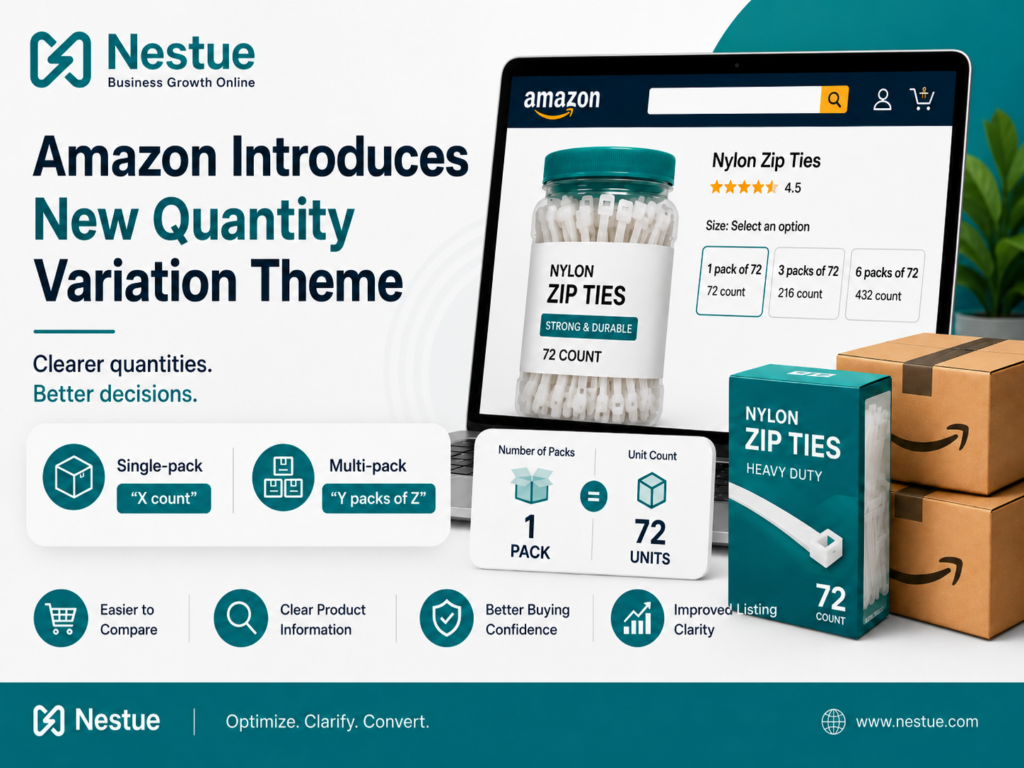
Amazon has introduced a new Total Product Quantity variation theme for sellers.
This update is important for Amazon sellers who offer products in different quantities, pack sizes, bundles, or multi-pack configurations.
According to Amazon’s Seller Central update, the new variation theme has launched across 193 product types, mainly in hardlines categories, with plans to expand to more categories later in 2026. The purpose is to standardize how product quantities appear on Amazon listings so customers can compare options more easily.
For Amazon FBA sellers, this is more than a small catalog update.
It can affect how customers understand your product, compare pack sizes, choose variations, and make buying decisions.
What Is the Total Product Quantity Variation Theme?
The Total Product Quantity variation theme is a new Amazon variation structure designed to make quantity-based listings clearer.
Instead of showing confusing pack sizes or inconsistent quantity labels, Amazon wants sellers to display quantity in a more standardized format.
For example:
- Single-pack products may display as “X count”
- Multi-pack products may display as “Y packs of Z”
This helps customers understand what they are buying before they click Add to Cart.
As a result, quantity-based variations can become easier to compare on the same Amazon product detail page.
Why This Update Matters for Amazon Sellers
Many Amazon listings use quantity variations.
However, quantity information is often unclear.
For example, one seller may write “72 count,” another may write “Pack of 72,” while another may list “6 packs of 12.” These may look similar, but they can create confusion for shoppers.
The new Amazon Total Product Quantity variation theme can help improve:
- Product listing clarity
- Customer shopping experience
- Pack size comparison
- Variation accuracy
- Conversion rate
- Review trust
- Catalog consistency
- FBA product listing quality
Therefore, sellers should review existing quantity-based variations and check whether this theme makes sense for their products.
Table: Old Quantity Setup vs New Quantity Theme
| Area | Older Quantity Setup | Total Product Quantity Theme |
| Quantity Display | Can look inconsistent | More standardized |
| Customer Understanding | May cause confusion | Easier to compare |
| Pack Details | Sometimes unclear | Shows unit count and pack count |
| Listing Structure | Depends on seller setup | More organized format |
| Conversion Impact | Can lose unsure shoppers | May improve buying confidence |
| Catalog Accuracy | Mixed across categories | Better consistency |
Graph 1 Placement: Customer Clarity by Quantity Display
Add graph here after the table.
Graph title: How Clear Quantity Display Can Improve Customer Understanding
Suggested graph type: Bar chart
| Quantity Display Type | Customer Clarity Score |
| Unclear pack title | 35 |
| Manual quantity text | 55 |
| Standardized unit count | 75 |
| Total Product Quantity theme | 90 |
Graph note:
This graph can show how standardized quantity variations may help customers understand product options faster.

What Sellers Need to Provide
If sellers select the new Total Product Quantity variation theme, Amazon requires quantity-related attributes.
Amazon’s update says sellers using this theme must provide Unit Count and Number of Packs. Unit Count means the total number of individual units in the package, such as 72 pods, 24 bottles, or 100 tablets. Number of Packs means the number of separately packaged groups, such as pack of 1, pack of 3, or pack of 6.
For example:
A single box containing 72 zip ties would be:
- Number of Packs: 1
- Unit Count: 72
A listing with 3 boxes, each containing 72 zip ties, would be:
- Number of Packs: 3
- Unit Count: 216 total units, depending on how Amazon requires the attribute for that product type
Because attribute behavior can vary by product type, sellers should always check the exact fields inside Seller Central before updating listings.
Why Unit Count and Pack Count Matter
Quantity mistakes can hurt customer trust.
If a shopper thinks they are buying 3 packs but receives 1 pack, that can lead to negative reviews, returns, and customer complaints.
Clear quantity data helps customers understand:
- How many units are included
- How many packs they will receive
- Whether the offer is single-pack or multi-pack
- Which option gives better value
- Which child ASIN matches their need
In addition, clearer variation details may reduce confusion before purchase.
That can improve the customer experience and support better Amazon listing conversion.
Graph 2 Placement: Quantity Variation Impact Areas
Add graph here in the middle of the blog.
Graph title: Where Quantity Variation Clarity Can Help Sellers
Suggested graph type: Bar chart
| Area | Impact Score |
| Customer understanding | 90 |
| Add-to-cart confidence | 80 |
| Reduced confusion | 85 |
| Review trust | 70 |
| Listing consistency | 88 |
| Conversion potential | 78 |
Graph note:
This graph can show how better quantity variation structure may support listing performance.
Is the New Variation Theme Required?
Amazon’s current update says the Total Product Quantity variation theme is optional for both new and existing listings. However, if sellers choose this variation theme, the unit count will be required.
This means sellers do not need to rush into every listing immediately.
However, they should review whether the new theme can improve product clarity, especially for products sold in multiple quantities.
Good examples may include:
- Zip ties
- Bottles
- Pods
- Capsules
- Filters
- Hardware packs
- Storage items
- Cleaning supplies
- Office supplies
- Small parts
- Multi-pack household products
If quantity is a major buying factor, this theme may be worth reviewing.
When Should Sellers Use This Theme?
Sellers should consider the Total Product Quantity variation theme when quantity is the main difference between child ASINs.
For example:
- 1 pack vs 3 pack vs 6 pack
- 24 count vs 48 count vs 72 count
- 1 box vs 2 boxes vs 4 boxes
- 10 pieces vs 50 pieces vs 100 pieces
However, sellers should not use this theme for unrelated products.
Amazon variations should still follow proper parent-child listing logic. Products should be similar and differ only by an allowed variation attribute.
Seller Checklist for Quantity Variations
| Checklist Item | What to Review | Why It Matters |
| Variation Theme | Check if Total Product Quantity is available | Confirms category support |
| Unit Count | Total individual units in package | Improves quantity clarity |
| Number of Packs | Separately packaged groups | Helps customers compare pack sizes |
| Child ASIN Accuracy | Each variation has correct quantity | Prevents customer confusion |
| Title and Images | Match the actual pack quantity | Builds trust |
| Pricing | Check price per unit logic | Helps customers understand value |
| Inventory | Track each pack size separately | Avoids stockout issues |
| Compliance | Follow Amazon variation rules | Reduces listing risk |
Common Mistakes Sellers Should Avoid
Quantity variations can create problems when sellers do not set them correctly.
Common mistakes include:
- Mixing unrelated products in one variation family
- Using the wrong pack count
- Confusing unit count with number of packs
- Showing the wrong quantity in product images
- Using titles that conflict with variation data
- Not updating backend attributes
- Creating duplicate child ASINs
- Not checking category support
- Assuming old variation themes will always remain best
Instead, sellers should review quantity-based listings carefully and update only when the new theme improves clarity.
How This Can Improve Amazon Listing Conversion
Conversion rate depends on customer confidence.
When quantity is unclear, shoppers hesitate.
They may leave the listing, compare competitors, ask questions, or avoid buying because they are unsure what they will receive.
A clearer quantity variation structure can help shoppers decide faster.
This may improve:
- Add-to-cart rate
- Product page trust
- PPC conversion
- Organic sales
- Customer satisfaction
- Review quality
- Return reduction
Therefore, this update can support Amazon listing optimization, especially for sellers with multi-pack offers.
How Nestue Helps Amazon Sellers With Variation Strategy
At Nestue, we help Amazon sellers review variation structure as part of listing optimization.
Our team checks:
- Parent-child variation setup
- Quantity-based child ASINs
- Unit count accuracy
- Pack count clarity
- Listing image accuracy
- Product title consistency
- Review and rating strategy
- PPC performance by variation
- Inventory planning by pack size
- Conversion improvement opportunities
This helps Amazon Private Label sellers build listings that are easier for customers to understand and easier to scale.
Final Thoughts
Amazon’s new Total Product Quantity variation theme is a useful update for sellers with quantity-based products.
It can help standardize how single-pack and multi-pack products appear on Amazon, making it easier for customers to compare options.
For now, the theme is optional. However, sellers should review their existing listings and decide whether it can improve clarity, trust, and conversion.
A small catalog improvement can make a big difference when customers are comparing similar products.
Clear quantity information helps customers buy with confidence.
CTA
Do your Amazon quantity variations look confusing to customers?
Book a free Amazon listing audit with Nestue and let our team review your variation theme, unit count, pack count, listing images, and conversion gaps.
FAQs
What is Amazon’s Total Product Quantity variation theme?
It is a new variation theme that standardizes how total product quantity appears across selected Amazon product types.
Is the Total Product Quantity variation theme required?
Currently, Amazon says it is optional for new and existing listings. However, if sellers select it, unit count is required.
What is Unit Count on Amazon?
Unit Count is the total number of individual units in the package, such as 72 pods, 24 bottles, or 100 tablets.
What is Number of Packs on Amazon?
Number of Packs is the number of separately packaged groups in the listing, such as pack of 1, pack of 3, or pack of 6.
Can this improve Amazon conversion rate?
Yes, it may help because customers can compare quantity options more clearly and understand what they are buying.
How can Nestue help?
Nestue helps sellers review Amazon variation themes, parent-child listings, quantity attributes, listing optimization, and conversion strategy.