
Lean Amazon PPC Launch Strategy: Rank With 5 Keywords, Not 50
Lean Amazon PPC Launch Strategy: Rank With 5 Keywords, Not 50
Many Amazon sellers launch PPC campaigns with too many keywords.
They believe more keywords mean more traffic, more sales, and faster ranking. However, this approach often burns cash before the product has enough data to scale.
A new Amazon product does not need forty or fifty keywords on day one.
It needs a small group of high-intent keywords chosen with purpose.
This is the idea behind a lean Amazon PPC launch strategy.
Instead of spreading budget across too many targets, sellers focus on five carefully selected keywords that can drive relevant clicks, improve conversion, and build keyword ranking with more control.
Why Most Amazon PPC Launches Waste Budget
Amazon product launches are expensive.
You need inventory, images, listing content, PPC budget, reviews, ranking support, and cash flow. Because of this, every click matters.
Many sellers waste launch budget because they:
- Target too many keywords
- Mix broad, phrase, and exact match too early
- Chase high-volume keywords only
- Ignore buyer intent
- Spread budget across weak terms
- Launch without conversion data
- Try to rank for everything at once
As a result, campaigns collect noisy data instead of meaningful performance signals.
A lean Amazon PPC launch avoids this mistake.
Why Five Keywords Can Be Enough
A new product does not need every possible keyword.
It needs the right keywords.
Five focused keywords can be enough when they are selected based on:
- Buyer intent
- Search relevance
- Conversion potential
- Competitor position
- Listing match
- Ranking opportunity
- PPC budget capacity
- Profit margin
In addition, fewer keywords make it easier to monitor performance and make decisions quickly.
When your PPC structure is simple, you can see what is working.
Table: Lean PPC Launch vs Broad PPC Launch
| Area | Broad Launch Strategy | Lean Launch Strategy |
| Keyword Count | 40–50 keywords | 5 focused keywords |
| Budget Control | Weak | Strong |
| Data Quality | Noisy | Clear |
| Optimization Speed | Slow | Faster |
| ACoS Risk | Higher | More controlled |
| Ranking Focus | Scattered | Concentrated |
| Best Use | Mature accounts | New product launches |
Graph 1 Placement: Budget Spread Comparison
Add graph here after the table.
Graph title: How Launch Budget Gets Split
Suggested graph type: Bar chart
| PPC Launch Type | Budget Per Keyword |
| 50-keyword launch | 2 |
| 25-keyword launch | 4 |
| 10-keyword launch | 10 |
| 5-keyword launch | 20 |
Graph note:
This graph shows how a smaller keyword set gives each target more budget and cleaner data.
How to Choose the Right 5 Keywords
The success of this strategy depends on keyword selection.
You should not choose five keywords randomly. Instead, each keyword should serve a clear purpose.
A strong five-keyword launch set may include:
- One main keyword with strong search demand
- Two high-intent mid-volume keywords
- One long-tail conversion keyword
- One competitor or niche positioning keyword
This gives the product a balanced launch structure.
You are not only chasing traffic. You are targeting relevance, conversion, and ranking opportunity.
The 5-Keyword Launch Framework
Here is a simple framework Amazon sellers can use.
| Keyword Type | Purpose | Example Use |
| Main Keyword | Build category relevance | Core product term |
| Mid-Volume Keyword 1 | Capture buyer intent | Feature-based search |
| Mid-Volume Keyword 2 | Expand ranking opportunity | Use-case search |
| Long-Tail Keyword | Improve conversion rate | Specific buyer need |
| Competitor/Niche Keyword | Position against alternatives | Comparison or niche term |
This framework keeps the launch focused but not too narrow.
Why Keyword Intent Matters More Than Keyword Count
A keyword with high search volume is not always the best launch keyword.
For example, a broad keyword may generate clicks but low conversions. Meanwhile, a long-tail keyword may have lower search volume but stronger buying intent.
During a launch, conversion matters.
Amazon needs signals that shoppers are clicking and buying your product for specific search terms.
Therefore, high-intent keywords are often more valuable than large keyword lists.
Graph 2 Placement: Keyword Intent vs Launch Value
Add graph here in the middle of the blog.
Graph title: Keyword Intent Can Beat Keyword Volume
Suggested graph type: Bar chart
| Keyword Type | Search Volume | Launch Value |
| Broad keyword | 95 | 45 |
| Mid-volume keyword | 70 | 75 |
| Long-tail keyword | 45 | 85 |
| Niche keyword | 35 | 70 |
Graph note:
This graph shows that launch value depends on intent and conversion potential, not only search volume.

Exact Match Should Be the Core of a Lean Launch
For a focused launch, Exact Match campaigns are usually important.
Exact Match allows sellers to control bids, budget, and ranking signals around specific keywords.
With fewer keywords, you can:
- Monitor spend clearly
- Optimize bids faster
- Track ranking movement
- Control Top of Search placement
- Reduce irrelevant traffic
- Build stronger keyword signals
Broad and Phrase Match can still be used later for discovery. However, the launch push should stay focused.
Why Too Many Keywords Delay Ranking
Ranking requires concentration.
If your PPC budget is spread across fifty keywords, each keyword may get too little traffic to produce meaningful ranking signals.
That creates weak data.
Amazon may not receive enough sales activity on any one keyword to understand where the product should rank.
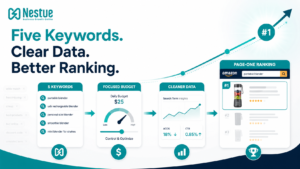
A lean PPC launch helps solve this problem by concentrating budget on fewer targets.
As a result, ranking efforts become more intentional.
Common Mistakes Sellers Make During PPC Launch
Many sellers lose money during launch because they try to move too fast.
Common mistakes include:
- Launching too many keywords
- Using only high-volume terms
- Ignoring listing conversion rate
- Scaling before reviews arrive
- Not checking keyword relevance
- Mixing discovery and ranking campaigns
- Not tracking organic rank
- Increasing budget without data
- Pausing keywords too early
- Forgetting profit per unit
Instead, sellers should build a focused structure first. Then, they can expand once the data supports it.
Lean Amazon PPC Launch Checklist
| Step | What to Do | Why It Matters |
| Choose 5 keywords | Select based on intent and relevance | Keeps launch focused |
| Use Exact Match | Control bid and budget | Improves data clarity |
| Track ranking | Monitor keyword movement | Shows launch progress |
| Watch conversion rate | Check if clicks become sales | Protects PPC budget |
| Review ACoS | Compare spend with sales | Controls profit loss |
| Improve listing | Fix images, price, and content | Supports conversion |
| Expand slowly | Add keywords after data | Prevents budget waste |
How Nestue Builds Lean PPC Launches
At Nestue, we do not launch Amazon PPC campaigns with random keyword lists.
We start with account and product data.
Our team reviews:
- Product category
- Competitor ranking
- Keyword intent
- Listing conversion potential
- PPC budget
- Profit margin
- Review position
- Launch timeline
- Inventory availability
- Organic ranking goals
After that, we build a focused PPC structure around the keywords that matter most.
This helps Amazon Private Label sellers launch with better control, cleaner data, and stronger ranking direction.
Final Thoughts
A new Amazon product does not need fifty keywords on day one.
It needs focus.
A lean Amazon PPC launch strategy helps sellers concentrate budget, reduce wasted spend, improve data clarity, and build ranking around the keywords that matter most.
More keywords do not always mean more growth.
Sometimes, five well-selected keywords can outperform fifty weak ones.
Launch lean. Choose with intention. Scale after the data proves it.
CTA
Planning a new Amazon FBA product launch?
Book a free Amazon PPC launch audit with Nestue and let our team identify the five keywords your product should focus on first.
FAQs
What is a lean Amazon PPC launch strategy?
A lean Amazon PPC launch strategy focuses on a small number of high-intent keywords instead of spreading budget across too many targets.
How many keywords should I use for a new Amazon PPC launch?
A focused launch can start with five carefully selected keywords, then expand after performance data becomes clear.
Why should Amazon sellers avoid too many launch keywords?
Too many keywords can spread the budget too thin, create noisy data, and make ranking harder to track.
Is Exact Match good for Amazon product launches?
Yes. Exact Match gives sellers better control over bids, budget, keyword ranking, and performance data.
Can five keywords help rank a new product?
Yes, if the keywords are relevant, high-intent, and supported by a strong listing, PPC budget, and conversion rate.
How can Nestue help with Amazon PPC launches?
Nestue helps sellers choose launch keywords, structure PPC campaigns, track ranking, optimize bids, and scale based on real data.